
Reporting · Explainers
How California Immigration Policy Got Here: A Timeline
From Proposition 187 to the sanctuary-state law and Medi-Cal expansion, California's approach to immigration has changed dramatically over three decades.
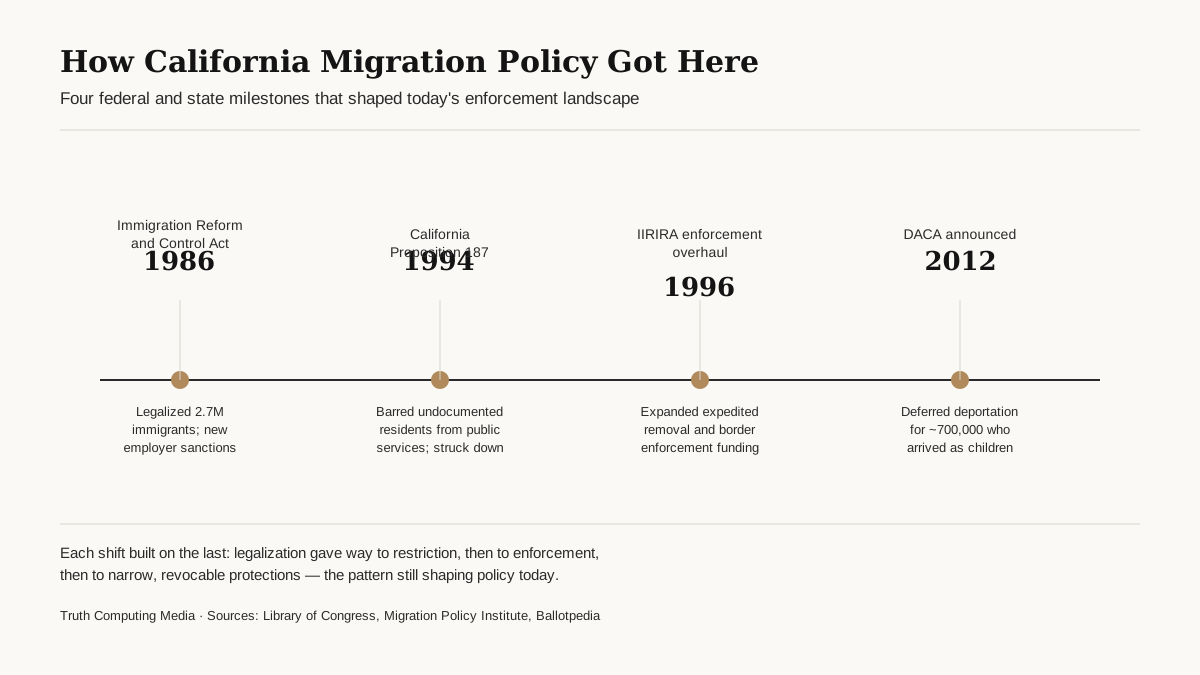
Six milestones behind California's current immigration policy landscape: 1994 Prop 187, 2001 AB 540, 2013 AB 60, 2017 SB 54, 2024 full Medi-Cal expansion, 2026 enrollment freeze. — Truth Computing Media
California's current immigration politics did not emerge all at once.
Over roughly three decades, the state moved from passing one of the country's most restrictive state immigration measures to adopting policies that expanded access to higher education, driver's licenses and healthcare while limiting some forms of cooperation with federal immigration authorities.
That history also isn't a straight line.
Immigration authority remains primarily federal. State laws operate around that federal system, shaping access to state services, law-enforcement practices, education and other parts of daily life.
The result is a California policy landscape built through elections, court rulings, legislation and repeated conflict with Washington. Here are some of the major turning points.
1994: Proposition 187 passes. California voters approved Proposition 187 with roughly 59% of the vote. The measure sought to deny many public services to undocumented immigrants and establish state mechanisms for determining immigration status. Its most consequential provisions were blocked in federal court and never took effect, and a 1999 settlement largely ended the remaining legal fight.
The political effects lasted far longer. Proposition 187 became a defining event in California immigration politics and is frequently cited as a turning point in the state's political relationship with its immigrant population.
Late 1990s: The legal fight over Proposition 187 ends. Federal courts concluded that core parts of Proposition 187 conflicted with federal authority over immigration. In 1999, California reached a mediated agreement ending the major remaining challenges. That did not end immigration debates in the state, but it established an important limitation: California could regulate areas within state authority, but it could not create its own parallel immigration-enforcement system.
2001: California expands access to in-state tuition. California enacted AB 540, creating a path for certain students, including some undocumented students, to qualify for in-state tuition at California public colleges if they met requirements based primarily on attending and graduating from a California school. This became an early example of California using education policy to reduce barriers faced by undocumented residents.
2011: The California Dream Act expands financial-aid access. California passed legislation allowing qualifying undocumented students to access certain forms of state and institutional financial aid. Together with AB 540, these policies created one of the country's more expansive state-level frameworks for undocumented students seeking higher education.
2013: California approves driver's licenses regardless of immigration status. AB 60 allowed eligible California residents who could prove identity and state residency to apply for a driver's license without demonstrating lawful presence in the United States. The licenses are marked differently from standard federally compliant identification and cannot be used for certain federal purposes. The policy reflected a broader state argument that licensing drivers could improve road safety and allow residents already living in California to participate more normally in daily life.
2014-2016: California expands some protections and services. During this period, the state adopted a series of laws affecting immigrant residents, including policies involving professional licensing, healthcare and interactions with law enforcement. The pattern was becoming clear: California was moving increasingly toward integration-oriented state policy even as immigration status itself remained under federal jurisdiction.
2017: California becomes a "sanctuary state." Governor Jerry Brown signed SB 54, the California Values Act. The law limits the circumstances in which state and local law-enforcement agencies may use their resources to assist federal civil immigration enforcement. It does not prevent federal immigration officers from operating in California, nor does it place immigration enforcement under state control. Its purpose is narrower: limiting certain forms of voluntary state and local participation in federal immigration enforcement. The policy became one of the clearest symbols of conflict between California and the first Trump administration.
2018: California and the federal government clash in court. The U.S. Department of Justice challenged several California immigration laws, including SB 54. The litigation reflected a larger constitutional struggle over the boundary between federal immigration authority and California's control over its own state and local institutions. Public opinion had also changed significantly from the Proposition 187 era — Public Policy Institute of California polling at the time found majority support for California taking its own actions to protect the legal rights of undocumented immigrants, although views remained sharply divided by party.
2016-2024: Medi-Cal eligibility expands in stages. California gradually expanded full-scope Medi-Cal eligibility to income-qualified residents regardless of immigration status. The expansion occurred by age group rather than all at once: children were covered first, then eligibility expanded to young adults, adults 50 and older, and eventually additional adults. By 2022, California officials said roughly 286,000 adults age 50 and older had obtained full-scope Medi-Cal through one of these expansions. The broader policy culminated in full-scope coverage becoming available to income-eligible Californians regardless of immigration status.
2024: California's immigrant population remains central to the state. By 2024, immigrants made up about 28% of California's population, according to the Public Policy Institute of California. California had approximately 10.9 million immigrants, more than any other state and roughly 22% of the entire U.S. foreign-born population. That helps explain why immigration policy in California extends far beyond the border — it affects schools, hospitals, workplaces, local police departments and communities throughout the state.
2025: Fiscal pressure begins changing the direction of healthcare policy. California's recent expansion of healthcare access encountered a new constraint: cost. As the state confronted budget deficits and higher-than-expected Medi-Cal spending, lawmakers approved changes that would limit future enrollment for some undocumented adults. The Legislative Analyst's Office described the change as a pullback from recent coverage expansions.
January 2026: California freezes new full-scope Medi-Cal enrollment for some undocumented adults. Beginning January 1, 2026, California stopped allowing certain undocumented adults age 19 and older to newly enroll in full-scope Medi-Cal. People already enrolled generally remain eligible if they continue meeting program requirements and renew on time. Children, pregnant people and certain former foster youth remain eligible regardless of immigration status under separate rules.
The change marks an important counterpoint to the previous decade. California remains substantially more expansive than federal policy in many areas, but state immigration-related policy is not moving in only one direction. Budget conditions, federal policy and political changes continue to reshape it.
What changed? The broad arc is striking. In 1994, California voters approved a measure intended to sharply restrict public services for undocumented residents. Three decades later, California had built policies intended to integrate undocumented residents into major parts of public life, including higher education, transportation and healthcare.
But calling that simply a shift from "anti-immigrant" to "pro-immigrant" would flatten the history. Different policies operate under different legal authorities. Courts have constrained some state actions. Federal administrations have changed enforcement priorities. California voters themselves remain divided on specific immigration questions. And fiscal pressures have begun limiting some recent expansions.
The more accurate story is that California has spent thirty years negotiating the boundary between two realities: immigration is governed largely by federal law, while immigrants live their daily lives inside states and cities. California's policies grew out of that tension, and that tension has not disappeared.
Truth Computing Media's immigration reporting has moved through Riverside, San Diego, San Ysidro, Los Angeles and Tijuana. The laws described here are the institutional background to those places — they shape who can drive, study, obtain healthcare, interact with local law enforcement and navigate public institutions. Understanding the reporting therefore requires understanding the policy history underneath it. This timeline is intended to provide that context.
Show the evidence+
- Multiple sources
Sources
- California Secretary of State: 25 years after the passage of Prop 187 — digital exhibit on its impact. Link
- California Department of Justice: Attorney General Lockyer files agreement ending major challenges to Proposition 187 (1999). Link
- Public Policy Institute of California: Proposition 187 and a changing California. Link
- Public Policy Institute of California: Californians and immigration policy — polling on SB 54 and related state action. Link
- Public Policy Institute of California: Immigrants in California — 2024 population data. Link
- Governor of California: Medi-Cal expansion provided 286,000 undocumented Californians with comprehensive health care (2022). Link
- California Legislative Analyst's Office: Considering Medi-Cal in the midst of a changing fiscal and policy landscape. Link
- California Department of Health Care Services: Immigration status and changes to Medi-Cal eligibility. Link
Method
Synthesized from public data and records rather than original field reporting.